We hear from Ian, walks leader, on his reflections on recently completing the Petworth Way LDW with several other FSD members this March.
“The Walks Programme occasionally ventures beyond its familiar circular format for something more ambitious: a multi-day linear walk from one point to another. These take a bit more organising (shuttling cars, booking overnight stays) but it’s worth it. There’s something different about finishing a walk knowing you’ve actually crossed a piece of countryside rather than looped back through it.
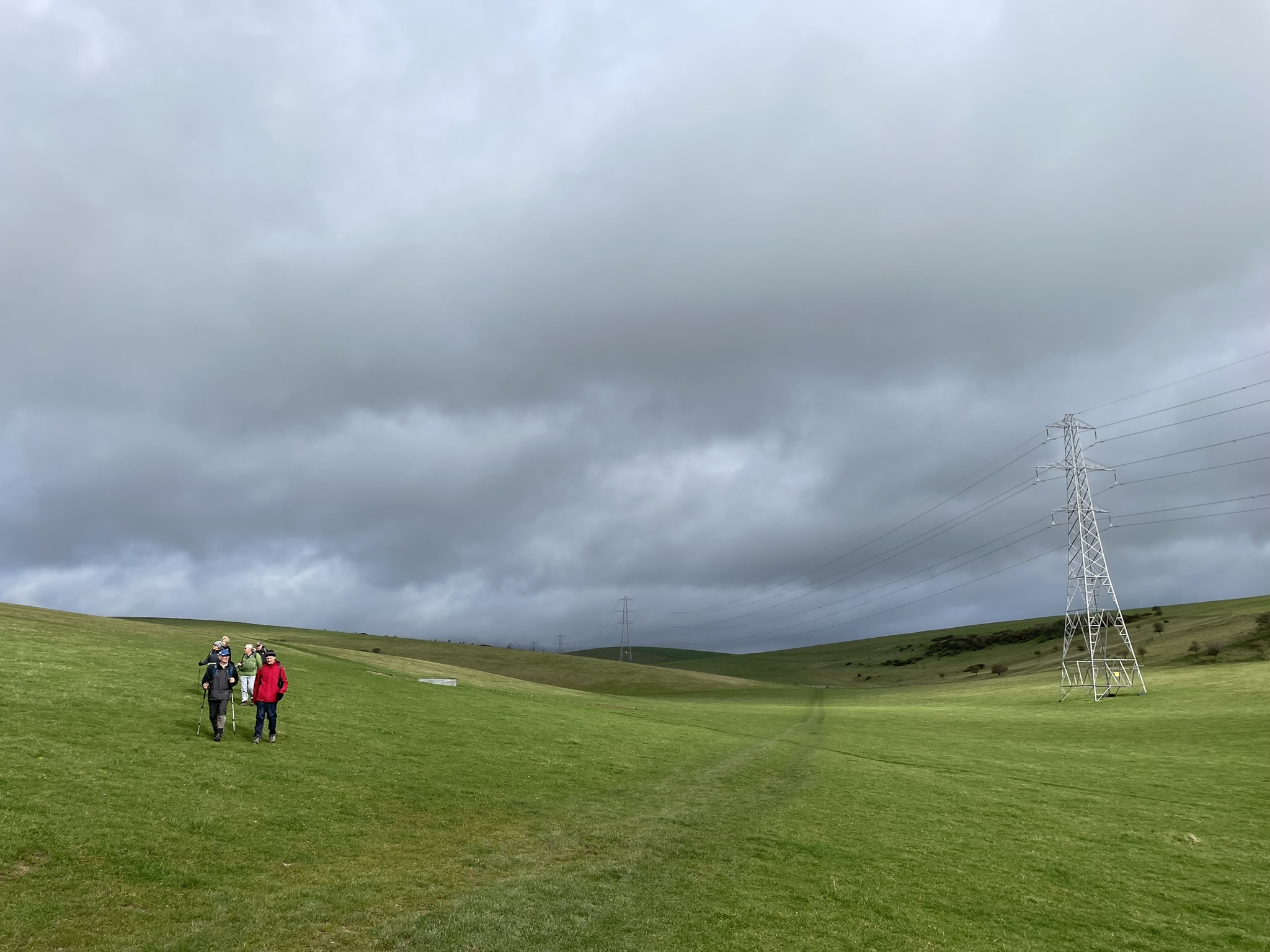
This quarter, our group took on the 25-mile Petworth Way, two days from Haslemere to Arundel via Petworth in glorious early-spring sunshine.
We had a treat before setting off. Gerald Gresham-Cooke, who created the Petworth Way with the help of Malinka van der Gaauw and is one of our own FSD walk leaders, joined us to introduce the route. His original plan was simple: give Londoners a way to take the train south and spend a couple of days on foot in West Sussex with an overnight stay in Petworth. It worked.
The walk delivered. Coffee at the Temple of the Winds on Blackdown, a pause on Lurgashall’s village green, a steep drop into the Arun Valley, and a fine finish through Arundel Park.
With the Petworth Way done, we’re already thinking about what comes next. The Q2 and Q3 programmes will feature the High Weald Landscape Trail, a six-day walk from Horsham to Rye and the most ambitious linear route the programme has taken on.”
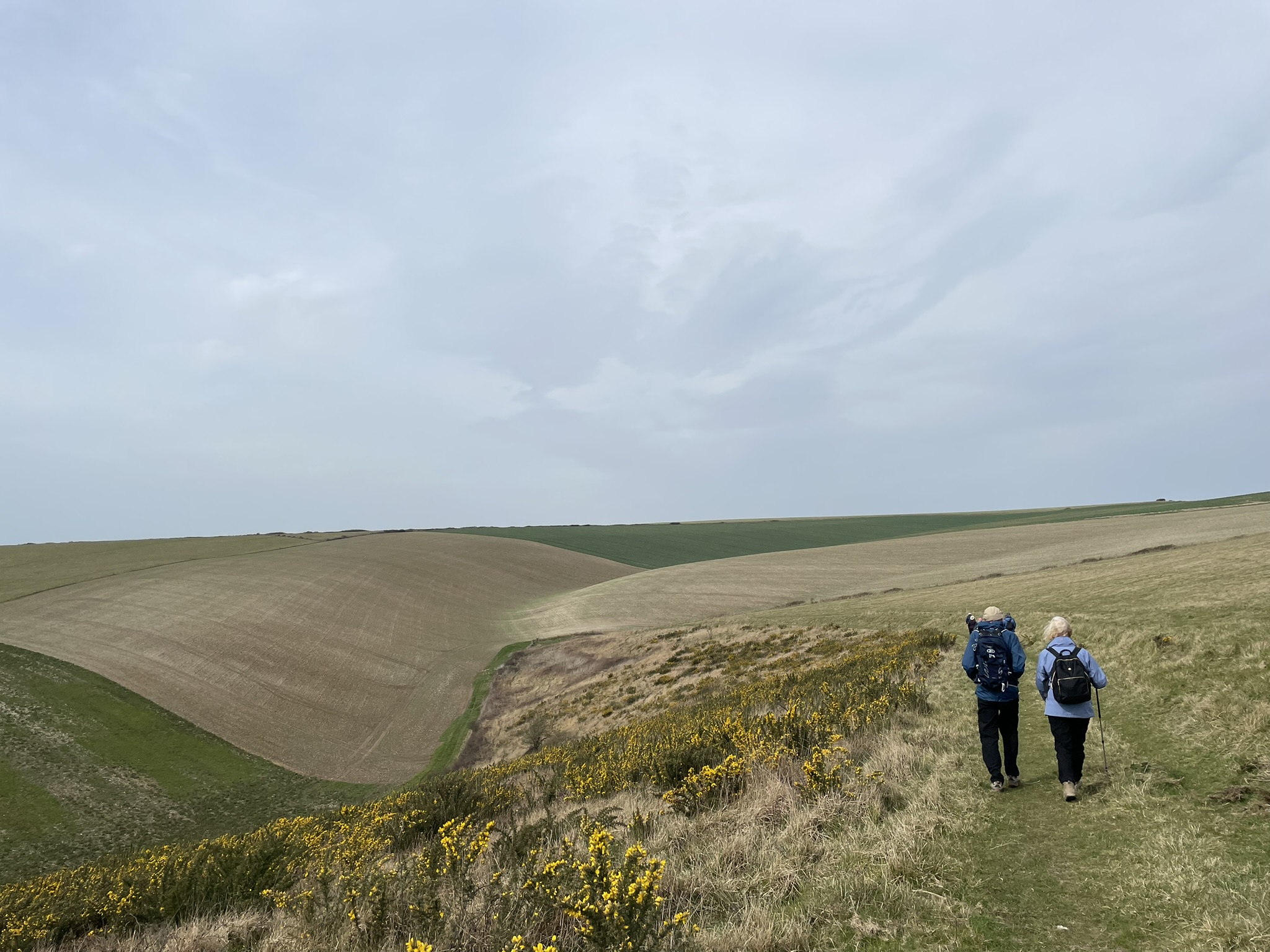
The view looking towards Amberley after crossing A29 at Bury Hill.
New report urges Government to stop pollution at source, fix the broken water system, and restore nature to England’s rivers, lakes and seas in next generation water reforms
A major coalition of environmental organisations have launched Clean Water Now, a new report setting out the urgent reforms needed in the upcoming Water Reform Bill.
Currently, sewage, farming pollution, and chemicals pollute rivers, lakes, and seas, with just 14% of English rivers in good ecological condition. Habitats are shrinking, wildlife is suffering, and people are getting sick. If Government doesn’t act now, this once-in-a-generation opportunity to change the rules could slip away, leaving England’s waters in decline for years.
The launch of the report marks the start of a new public campaign demanding ambitious action from Government, regulators, and industry. As a first step, campaigners are urging the public to email their MPs, calling them to back strong, enforceable measures to deliver clean water.
The report sets out three core demands for the Water Reform Bill:
Stop the polluters − clamp down on sewage, restrict intensive agriculture and ban toxic chemical pollution.
Fix the broken system − stop water companies putting profit before people and nature, with a tough new regulator focused on nature and local communities involved.
Restore nature − creating new natural habitats along rivers and coastlines, building natural resilience to climate change and bringing wildlife to communities around the country.
Mark Robinson, Senior Campaigns Manager at WWT, the wetland charity, said: “We are a nation of water-lovers with one, simple message – enough is enough. Now is the time for a plan that matches the reality of the crises facing our waterways, and recognises the essential role of nature in bringing them back to health. If we’re truly to turn the tide on pollution, the government must ensure this unique opportunity to reform the system brings us more water, more wetlands and more wildlife.”
The report argues that years of weak enforcement, regulatory failure, and political delay have allowed pollution from sewage, agriculture, and toxic chemicals to continue while wildlife has declined, and public trust has eroded. It calls for binding national targets, stronger regulators, and regional water authorities with real powers to plan and enforce action at catchment level.
As Parliament prepares to debate the Water Reform Bill, campaigners say half-measures will no longer be tolerated. Public support for clean rivers and beaches is overwhelming, and communities across the country are demanding change. British waters cannot wait. Read the full Clean Water Now report here and take action by telling your MP that you expect laws for water that stop polluters, fix what’s broken, and deliver clean water − now.
Campaign for National Parks has joined forces with protected landscapes bodies, leading environmental charities and conservation societies to call on Government to ensure any visitor levy properly supports National Parks and National Landscapes.
The Government announced plans in November 2025 to bring forward an overnight accommodation levy for Mayoral Authorities, and a consultation on the proposals has just closed. Campaign For National Parks (CNP) are very concerned that Protected Landscapes could lose out under the existing plans and that more emphasis needs to be given to these vitally important places. National Parks and National Landscapes are major drivers of regional tourism and rural economies, attracting millions of visitors each year. At the same time, high visitor numbers can place pressure on these fragile environments and small communities.
That’s why they’ve written to Steve Reed, Secretary of State for Housing, Communities and Local Government, insisting that any visitor levy introduced must ensure that revenues raised in and around Protected Landscapes are reinvested locally, with a clear focus on nature recovery and environmental protection.
We have added our name to the letter in support. The letter also calls for National Park Authorities and National Landscapes Partnerships to have a significant role in allocating funds, warning that without proper ring-fencing, money raised from visitors could be diverted elsewhere rather than supporting the landscapes that attract them in the first place.
How we are supporting Sussex Wildlife Trust with essential conservation at Ebernoe Wildlands Nature Reserve.
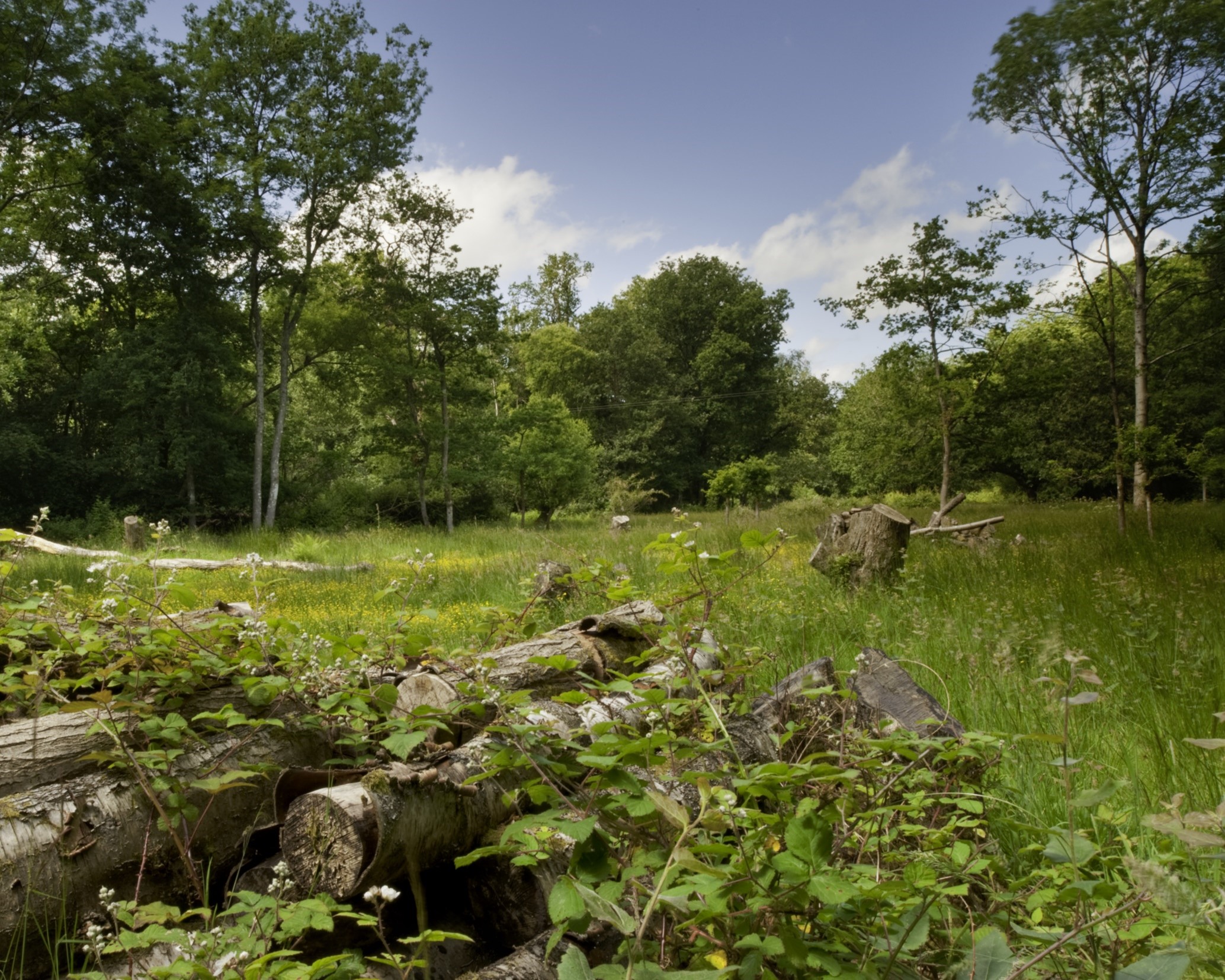
Ebernoe Wildlands Nature Reserve features one of the richest woodlands for wildlife in the South East. It is a matrix of dense woodland, sunny rides, open glades, and scrubby edges. Barbastelle and Bechstein’s bats, the rarest bats in Europe, make their homes in the dense woodland whilst amongst woodland glades you may spot Purple Emperor, White Admiral and Silver-washed Fritillary butterflies. If lucky, you may see, or hear, birds like Firecrest and Marsh Tit enjoying the kaleidoscope of scrubby habitats.
Ebernoe Common copyright Sussex WT Nigel Symington
This is one of Sussex Wildlife Trust’s (SWT) most important nature reserves. As such, it is often the subject of targeted nature reserve expansion as they seek to regenerate nature on a larger scale. Alongside Ebernoe Common lies Butcherlands, a rewilding area with management integrated with that of Ebernoe.
Key to the management of these reserves is grazing. Ebernoe Common is an ancient wood-pasture, managed for centuries through a combination of traditional woodland management and grazing. What we may call rewilding at Butcherlands is really just a modern take on wood-pasture, so also driven by grazing. Grazing is thus the main factor to create a habitat mixture of incredible diversity, and thus more living space for a greater variety of species.
Getting the grazing right is vital to maintain this matrix. Too much and the dense woodland reduces, and the bats suffer. Too little and the open glades and rides will disappear as trees shade out the species that thrive in sunlight. So SWT put their cows (“Sussex Reds”) onto the site for carefully planned periods. Just enough to get the balance right!
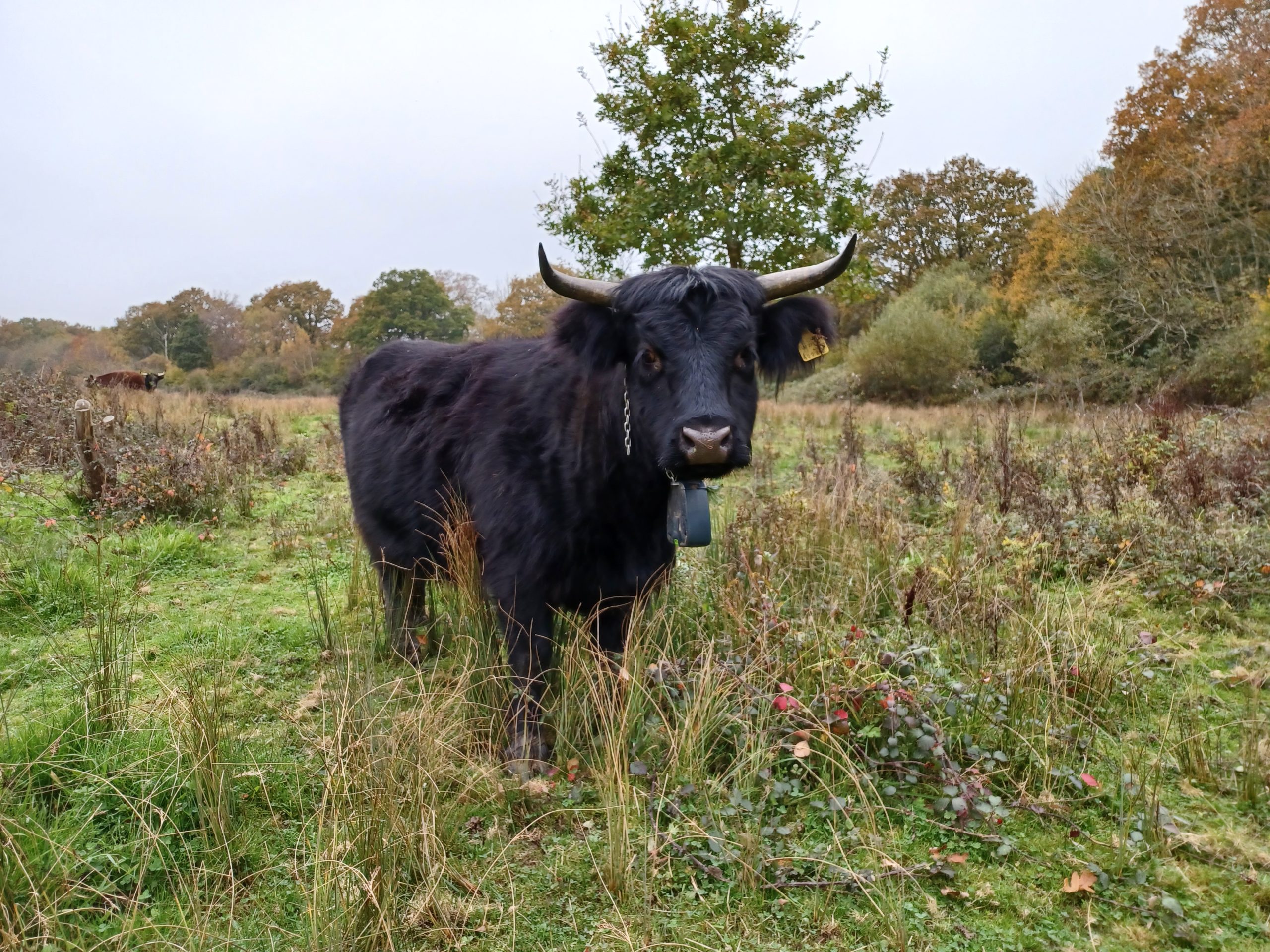
This works well, and SWT have amassed considerable experience in managing their cattle. One essential activity, however, is “lookering” – the checking of cattle every day. In an open field this is easy, but in this patchy woodland it can take hours. This can compromise SWT’s resources to deliver the necessary grazing regime. SWT endeavour to attach GPS collars to the cattle, emitting signals that can be picked up by a smartphone, allowing their position to be identified, and the wellbeing of all the cattle can be checked easily.
It may seem odd that the viability of a grazing project (and so the richness of wildlife on a nature reserve) comes down to a piece of electronic kit hanging round a cow’s neck. Yet this is the case. Friends of the South Downs have seen this as a key point at which our financial support can help. Funding for GPS collars enables SWT to manage their cattle more efficiently (and effectively) and so deliver a great diversity of wildlife at one of the most important nature sites in the South Downs.
And there is something romantic about seeing native Sussex Reds calmly grazing in the dappled shade of an open sunny woodland. It’s good for Friends to be a part of this project.
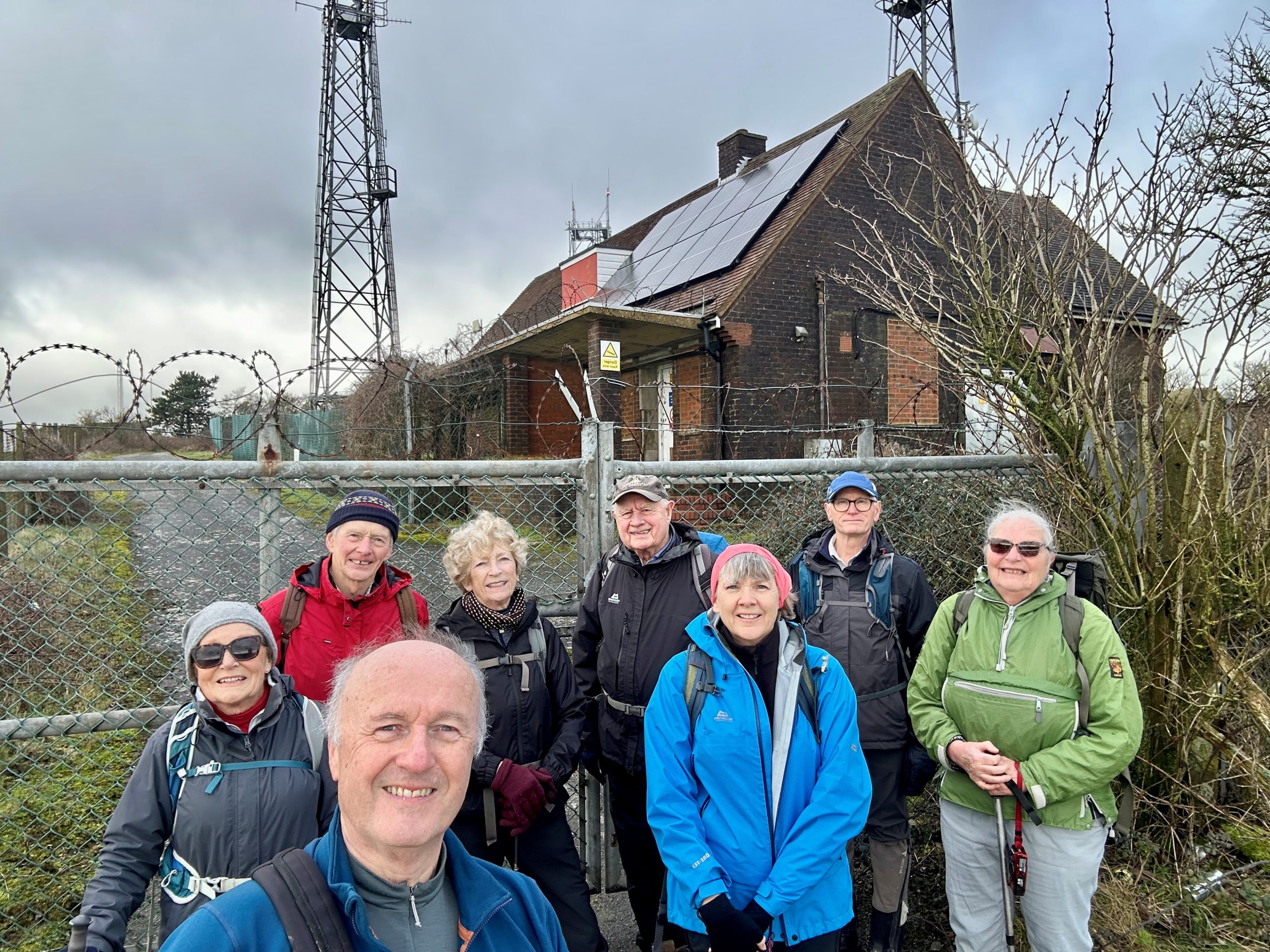
Trustee David Taylor recently led a guided walk around Truleigh Hill near Shoreham. During a coffee break, David spoke about RAF Truleigh Hill’s role as a radar site during WW2 and the early years of the Cold War.
Sitting at over 700 feet above sea level, Truleigh Hill became operational in July 1940, right at the height of the Battle of Britain. One of six Sussex radar sites at the time, Truleigh Hill’s contribution to victory in the battle cannot be overstated. The Germans poised just across the Channel were ready to invade, all they needed to succeed was control of the skies. Britain had introduced the world’s first integrated air defence system, just in time to give the RAF the advantage they needed. With early warning of an approaching air raid, RAF fighters could gain much needed altitude before entering any fight; the rest is history.
Later in the war, Truleigh Hill was selected as a location for ‘Gee’, a navigation system which gave allied bombers a much more accurate position, vital for effective targeting. This navigational aid role continued after the war and into the early 1950’s.
In 1949, the Russians detonated their first atomic bomb, and the threat of war returned. Truleigh Hill was upgraded to become part of the ROTOR network, an advanced radar system designed to detect incoming, high altitude bombers. The ‘bungalow’ in the image is actually the heavily fortified guardroom, built post-war and giving access to a tunnel. The tunnel led to an operations bunker, located 50ft underground and able to withstand a near-miss from a 20 kiloton atomic weapon.
By 1957 with the advent of the hydrogen bomb, and advances in radar technology, fewer and better protected sites were required and Truleigh Hill ceased operations. The site was sold into private ownership in 1965 and now serves the emergency services and private telecommunications.
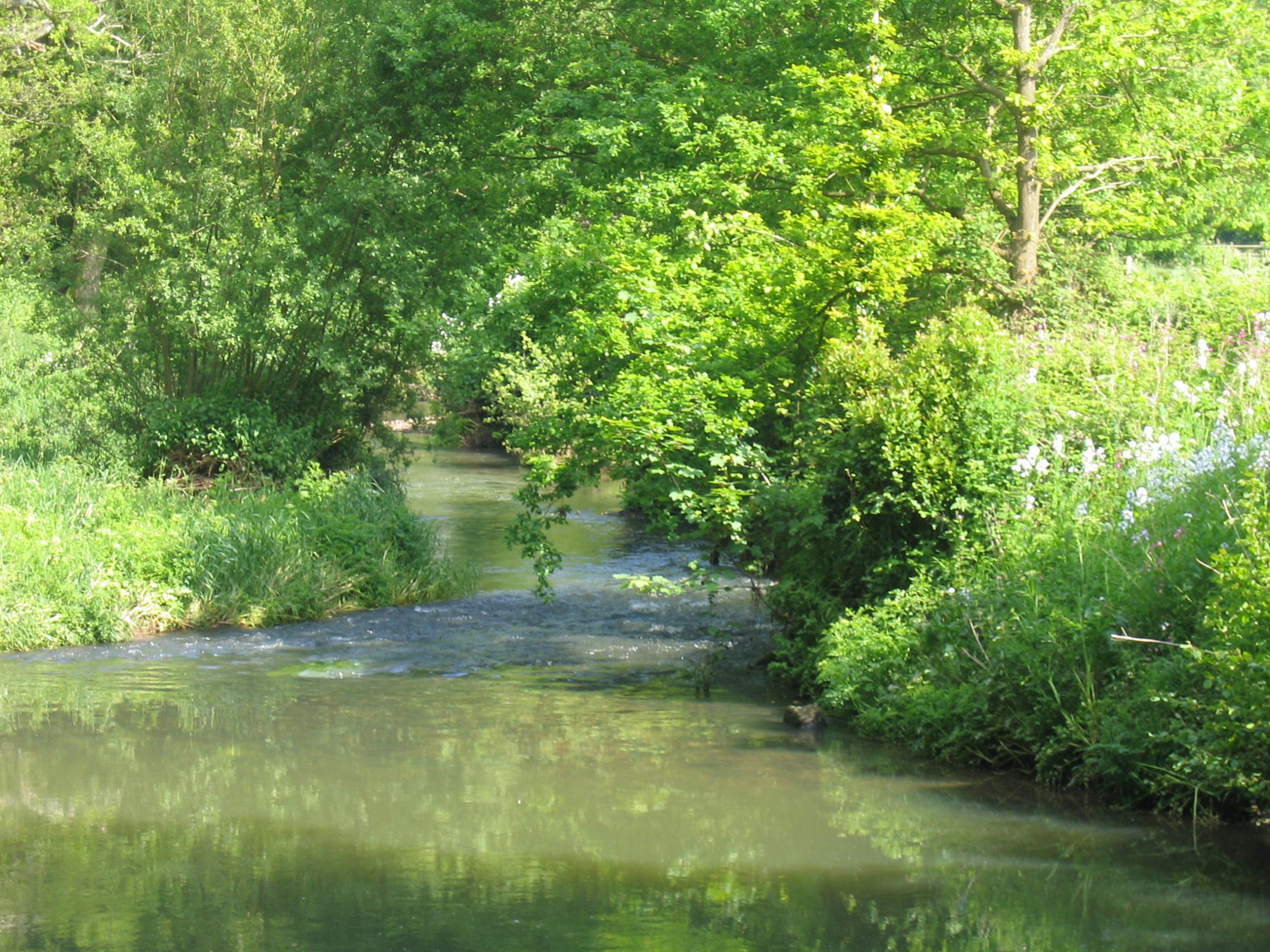
I hope you will have seen that the Campaign for National Parks (CNP) of which the Friends is, of course, a member has just published a Report, ‘Rivers at Risk’, on the state of rivers in the National Parks. Its findings make sobering reading, but sadly will not come as a surprise to anyone. You can read the report here.
The various river trusts operating within the Park are doing great work.
The CNP report under the heading ‘Citizen Science at the Forefront of River Health’ highlighted the contribution being made by ‘local communities and passionate campaigners in filling the gap left by environmental regulators in England and Wales’. This is where the Friends and you can make a valuable contribution; we by helping to fund the citizen science project being run by the Western Sussex River Trust and you by volunteering some of your time as citizen scientists.
Friends of the South Downs have recently funded the installation of replacement gates on the St Catherine’s Hill Nature Reserve, a beautiful chalk downland hill a mile or so south of Winchester. The Nature Reserve covers 47 hectares and is managed by Hampshire & Isle of Wight Wildlife Trust.
Janet Goody, Chair Access & Right of Way Committee
High on the Downs, from which there are magnificent views of the City of Winchester, the old gates were no longer fit for purpose. The bridleway on which the gates are installed is the Pilgrim’s Trail which follows the 155-mile medieval route from the shrine of St Swithun at Winchester Cathedral, via Portsmouth, to the sanctuary of Mont St Michel in Normandy.
In case any of you are wondering how many people will actually use the gates, the Marathon Runners and Walkers taking part in Against Breast Cancer’s recent Fundraiser passed through the gates!
St Catherine’s Hill Nature Reserve
The Nature Reserve is really worth a visit. Standing 70m above the Itchen Valley with 100+ steps on the north and south sides, there is also a flatter route via the surfaced footpath parallel to the Itchen Navigation, then along the unsurfaced bridleway along Plague Pits Valley. There are worn grass paths that criss-cross the hill, valley and ridge.
A dramatic 220ft climb up St Catherine’s Hill’s wooden stairs reveals showstopping views of Winchester city, as well as the Itchen Valley floodplains and the downland it nestles in. At the summit are the earthworks of an Iron Age fort, buried ruins of the Norman chapel that gives the site its name, and a copse of beech trees. In the summer you’ll be able to hear the cackle of a woodpecker, spy buzzards and kestrels hunting in the valley below, and meet our friendly British White cattle that graze the site to encourage wildlife to flourish. British white cattle and sheep graze the site to encourage wildlife to flourish.
St Catherine’s Hill is easily accessible by train and bus.
As the weather warms up, many of us look forward to spending more time walking and hiking on trails and in parks. However, a tiny menace awaits—Ixodes Ricinus, the blacklegged tick. Also known as the Deer Tick, these crafty parasites cling to vegetation waiting to latch onto passing animals or people, looking for a meal of blood. While going unnoticed, they can transmit Lyme disease, an illness you’ll want to avoid. Let’s look into stepping out smart by avoiding ticks. Protect yourself with some tick smarts before heading out on your next walk.
Ticks and Lyme Disease
Blacklegged ticks in their nymph stage are most likely to pass on Lyme. These poppy seed-sized insects are efficient transmitters of the corkscrew-shaped Lyme bacterium. Infected ticks secrete the bacteria into the skin when they insert their feeding tube.
What Are the Symptoms?
If a tick infected with the Lyme bacterium has fed on you, a rash might emerge on your skin around the bite within three to 30 days. The infamous ‘bullseye’ circular rash, called erythema migrans, appears in about 70-80% of infected people. Flu-like symptoms like fever, headache, stiff neck, swollen lymph nodes, and fatigue often accompany the rash.
Without treatment, more severe joint swelling and pain, heart palpitations, and neurological issues involving numbness, paralysis, and memory problems can occur. See a doctor right away if you experience any of these warning signs of Lyme after spending time outdoors. Prescription antibiotics at an early stage can treat the infection effectively.
When walkers return from wooded areas or fields with tall grass, they must perform thorough tick checks over every inch of exposed skin. Look carefully in warm folds around armpits, the groin, back of knees, scalp, and ears. Tiny young ticks are easy to miss.
Stepping Out Smart by Avoiding Ticks
The best defence to avoid close encounters with these disease-carrying freeloaders is to minimise exposure of unprotected skin by wearing trousers and long-sleeved shirts. Stick to trails and avoid sitting on logs or in tall grass. Apply a DEET repellent on exposed areas of skin. After returning from a walk in an infested area, immediately put clothes in the tumble dryer on high heat to kill stragglers. Check your body closely and document any tick finds. Prompt removal within 24 hours using pointy tweezers can stop disease transmission. If you remove a tick that has bitten you it can also be a good idea to bag in and put it in the freezer for later examination by the NHS if Lyme symptoms appear.
Ticks may be small, but the illnesses they can transmit pack a serious punch. With vigilance, preventative measures, and quick tick removal, walkers can continue to roam the landscapes they enjoy—without unwelcome fellow travellers tagging along.
The second of the Centenary prizes for academic work at Brighton University was awarded Thursday 5 October 2023 to Dom Jarvis, a Geography student, just starting his third and final year. Chairman David Sawyer and Paul Wilkinson were at Brighton University to present the Richard Reed Award, a newly created award, for most improved performance by a BSc/BA student in the department of Geography, Earth and Environment, based on results over 1st and 2nd years. The presentation took place in front of the final year class.
The Richard Reed Award is named after the Friends of the South Downs longest standing member who was not only Chairman three times but served the Society as a Trustee for an astonishing 59 years. The award is for the sum of £500 for the most improved performance by a BSc/BA student within Geography and Environmental Sciences/Management subjects. It is based on their academic results over their 1st & 2nd years.
This is the inaugural year for the Richard Reed Award supported by the Friends of the South Downs.
Dom Jarvis (centre) was presented with the award by Paul Wilkinson (right) Membership & Marketing Committee Chair for Friends of the South Downs and Dr Matthew Brolly (left), Principal Lecturer in Geography/Environmental Science.
Dom is here to tell us about himself:
FSD: Tell us where you grew up, Dom.
DJ: I grew up in a town called Upminster in Essex.
FSD: What made you realise you wanted to study geography?
DJ: Firstly, I have to thank my secondary school Geography teachers, they really sparked my interest in the subject and managed to teach in a very engaging and fun way. Throughout school, Geography was always my favourite subject so that, combined with my love for beautiful landscapes, it was a no brainer.
FSD: Why did you decide on Brighton Uni?
DJ: I decided on Brighton because of its diversity. Not sure if you have ever been to Essex but it has a stereotype and it is pretty accurate! Brighton has all different types of streets, shops and people so that was the primary pull factor. Essex is all the same old, same old…
FSD: You’ve been surrounded by the South Downs landscape for your time at Uni. What is your relationship with the Downs?
DJ: Having stayed in Varley Park accommodations for my first year of studies, Stanmer park was right across the road (literally) so that was my go-to green space for walks. I loved it. It has the perfect mix of open green space and dense forest to get lost in and it was great for my mental health when settling into university! I have also cycled to Devils Dyke with my friend and after some pretty serious incline, it was all worth it for the view! Cycling along the coastline also provides a great sense of relief with the views and salty wind hitting your face.
Richard Reed
We also caught up with Richard Reed.
FSD: Would you like to say anything about the recently awarded Richard Reed award?
RR: I was delighted to learn that Dom Jarvis had won the prize for the most improved performance. The study of geography is an ideal way to appreciate the wonders of the world, not least our own South Downs. I look forward to the Friends of the South Downs working closely with Brighton University to understand better our glorious landscape.
The Awards
The University awards were part of a spending programme for the Friends of the South Downs’ Centenary Year. The Trustees agreed a major programme of spending totalling over £100,000 in this year to benefit the Downs in the short term and the long term. The Friends can spend this money because they are fortunate to have recently received two substantial legacies.
You can help us make these legacies go even farther by supporting us. Consider joining us as a member, donating to our cause today or remembering us by creating a legacy.
The first of our Centenary prizes for academic work at Brighton University was awarded at the main University-wide graduation ceremony on Friday 28 July 2023 at the Brighton Centre. The Robert Thurston-Hopkins award for the highest achieving BSc/BA student in the Department of Geography, Earth & Environment, was awarded to Elizabeth-Jane Pallett (Lizzie).
Lizzie Pallet
Lizzie also won the BSc Environmental Sciences Prize. In her studies, she specialised in extinct volcanoes in Wales. She plans to use our £500 prize to help fund her spending next year in Japan, learning the language. She’ll follow that by studying for an MSc in Japan the following year, not surprisingly specialising in active volcanoes in that country.
David Green and Paul Wilkinson, accompanied by Joanna Thurston Hopkins (granddaughter of the Society’s founder), attended the graduation ceremony.
David Green, Dr Kirsty Smallbone (Dean of the School of Applied Sciences at Brighton Uni), Lizzie Pallett (winner of the Robert Thurston Hopkins award), Joanna Thurston Hopkins, Paul Wilkinson
Lizzie told us a bit about herself:
FSD: Where did you grow up?
Lizzie: I grew up in North Cornwall, in a little village in a valley, and I was always surrounded by nature throughout my childhood. I loved being in the countryside, but it was hard to find work here that I was truly passionate about.
FSD: What made you realise you wanted to study geology?
Lizzie: I had always been interested in Japan for the language and culture, and in 2020 just before COVID struck, I took a six-week trip out there by myself to learn the language. I had never felt like I belonged somewhere more, being surrounded by the amazing mountains in such a geologically fascinating part of the world, in addition to the humble and hard-working citizens there. After having to return home in April just as COVID was hitting and I had to evacuate the country, I knew I had to go to university so I could return to Japan qualified to live and work there. I applied to the only university I wanted to study at – Brighton!
FSD: Why did you decide on Brighton Uni?
Lizzie: I had fond memories visiting Brighton as a child with my family, and I knew that coming from the countryside I would enjoy what Brighton has to offer – the beautiful Downs and the chalk cliffs, and the cosy coastal city that feels familiar without being too daunting (like London for example!) I knew I wanted to study something environmental after I had made a speech at a local council meeting to support renewable energy projects in our local area, as I remember feeling really passionate about it and that I might make a difference, but it wasn’t until I started my BSc Environmental Sciences course that I became fascinated with geology – particularly igneous rocks and volcanoes. So, though geology wasn’t a huge focus of my course, I decided to write my dissertation on the subject so that I could find out more. Despite the huge challenge it was to pursue an unknown subject as a year-long independent project (with the assistance of my fab supervisors Dr Laura Evenstar and Dr Jake Ciborowski), I was still motivated to finish it to the best of my ability. I knew I was passionate about the subject! I really hope to be able to start a career in geology in Japan (or Iceland – another very geologically fascinating country). I will be leaving to study Japanese in Hokkaido for three months from September and job hunting while I’m there.
FSD: You were surrounded by the South Downs landscape for much of your Uni life. What is your relationship with the Downs?
Lizzie: Throughout my university experience, I frequently took hikes into the Downs to wind down from studying and escape the city life – even lovely Brighton could be a bit overwhelming to a country girl like me. So, it was a great comfort to be able to get away from the traffic and energy of the city and traverse the rolling hills of the Downs. Visiting Devils Dyke, Ditchling Beacon and taking long late-night hikes to the Chattri Memorial are all great memories I have with the Downs, and I feel very lucky to have been able to study my degree amidst such a beautiful landscape.
Elizabeth-Jane Pallett: “Thank you so much for the Robert Thurston-Hopkins award. I am honestly blown away. I am so humbled to receive such a generous donation and I plan to put it to good use! Whilst I worked my utmost hardest to do my best at university, I couldn’t have imagined that I would be able to win such an award and I am so grateful for the recognition of my efforts and the money that will support me to achieve my goals. In September, I will be travelling to Japan for a three-month language course in Hokkaido to improve my Japanese skills so I can one day become a volcanologist in Japan – hopefully! This award will be so helpful in getting me one step closer to that goal. Thank you so much for your kindness and generosity, it means so much!”
Joanna Thurston-Hopkins: “I was very pleased to see my grandfather’s name go on in the form of the Friends of the South Downs Robert Thurston-Hopkins award, with Elizabeth-Jane Pallett as the inaugural winner. She is a very worthy recipient, who is a credit to herself and her university.The event had an extra, rather unexpected, meaning for me personally, as not only did my father the Photographer (Godfrey) Thurston Hopkins go to Art school here in the 1920’s, but there was a strange moment when I looked out across the multitude of recipients of Doctorates, one of whom, (until she died in 2021) had been my mother, the Photojournalist Grace Robertson. Somehow, I almost expected to see her face amongst the sea of robes! Thank you very much for giving me the chance to give back and connect with a part of my family history.”